
Pediatric
Summary of Pediatric Development
During the pediatric and adolescent years there is a lot of growth and development happening that affects all of their systems, functional abilities, and psychosocial development. Each child we see as therapists is going to be at a different stage in their development, making it important to know how each stage presents and how it will affect treatment. We also need to understand how a child's psychosocial development will affect how their learn and communicate. That is why a true life span perspective of development includes all changes occurring as part of the continuous process of life.
When it comes to primitive reflexes, they are first part of the brain to develop and should only remain active for the first few months to a year of life. In normal development, these reflexes begin to inhibit during the first year, and replacement reflexes, called postural reflexes, show up. Retaining these primitive reflexes can cause developmental delays and affect balance, coordination, sensory perception, and fine motor skills. It is important to test the child's primitive reflexes and make sure they are integrated properly and at the right time. Having this information allows us to see if the child is developing properly and at the right pace. That way, if there is an issue that arises we can detect it early in their development and correct it.
Functional movements are those movements used to meet basic needs, perform daily tasks, accomplish goals, and engage in purposeful activity. Children have different functional abilities and needs than adults do so it is important to know what they are capable of at each age and where their abilities should be at during each stage of development. Never in the life span does an individual undergo such a rapid rate of change as during their first year. It is important to note that when looking at functional movements for pediatrics the focus should not be so much on the age that they are but rather on the process that happens as the newborn transforms from a dependent to an independent mover by the end of the first year, then active toddler, and adolescent.
So, when it comes to pediatrics it is important to assess where they are at in the developmental process and use that information to guide our treatment. With kids it is also important to take into account their psychological development and learning styles. With pediatrics they tend to learn better when "play" is involved. This is also true when it comes to therapy. We as therapist need to try and incorporate elements of play when we are treating pediatrics allowing them understand and participate in therapy interventions in a way that makes sense to them. Children are more likely to participate in therapy if we make it a game or challenge.
Communication with pediatrics is also very different when compared to how we treat the adult population. We need to try and explain to the child why you are doing an intervention without going "over their head" but at the same time making sure they understand. It is also important to make sure that their parents understand what is happening and why. The parents can even help to explain to the child in a way that they understand because they know how their child learns.
Overall, understanding development is more important when it comes to the pediatric and adolescent population than adult due to the vast amount of change that happens during a short amount of time and how it changes the way we treat them.
SYSTEMS DEVELOPMENT

Nervous:
Some of the major changes that happen during the pediatric and adolescent phases are continued brain growth and myelination in all the lobes of the brain by the end of the first year continuing at slower rates during adolescence as well as neuronal growth and maturation with increasing complexity of neuronal process. The functional implications are dependent on postnatal sensory/ motor experiences and during adolescence motor control becomes more automatic with max precision happening by age 18-21.
Some of the rehab implications that can be seen in the nervous system during the pediatric and adolescent years are deficits in development and lack of functional ability. Finally, the way that we can use this information as a PTA is to understand that the child's current stage of neural development is directly related to functional ability and later in adolescence practice is related to skill.

Somatosensory:
During the first few months of life the somatosensory system and proprioceptive pathways are highly developed and during adolescence myelination, maturation and integration of somatosensory processing continue. The functional implications include interaction with tactile stimuli early in infancy and interaction with the world produces physiological changes in neuronal structures and efficiency. Somatosensory info integrates with vestibular and visual info, contributing to beginning sensory-motor mastery. The implications for rehab are early stimulation activities to emphasize both sensory and motor experiences because both sensory and motor development are intertwined at this point. Also, integration of somatosensory info with other sensory modalities develops the ability to plan motor action and move about in space, called praxis; difficulty with this ability can result in developmental dyspraxia. In adolescence lack of exposure to stimuli and novel opportunities can result in limited skill refinement.
As a PTA this information helps us to understand that during the first few months this system is the most developed making it important to give early tactile input to help develop sensory-motor skills. Infants are born prepared to receive and transmit somatosensory info, so early touch and attachment is important. During adolescence their body image of themselves is emerging during this stage, so that is something else we need to be conscious of when choosing location or format of session with them.
Visual:
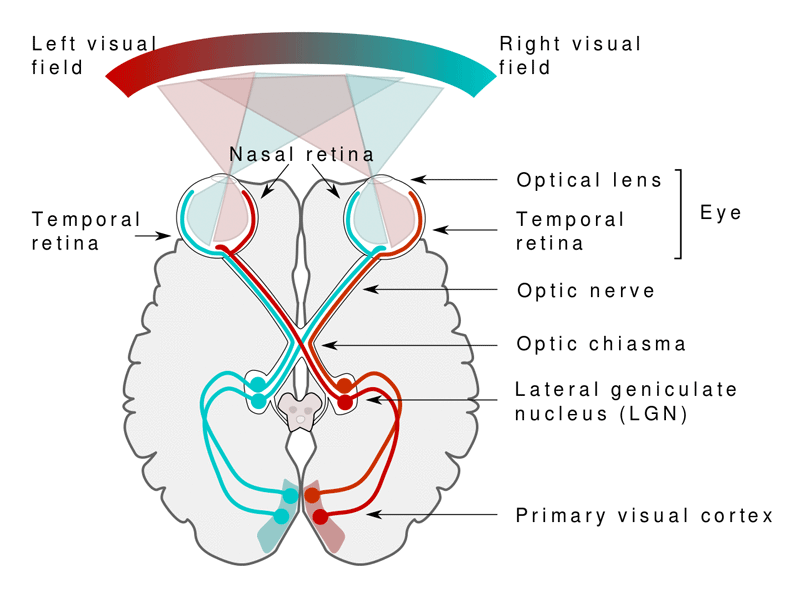
During infancy major changes that happen in the visual system are that central pathways develop, binocular vision matures by 3-5 months and 20/20 vision developed by the end of year 1. During adolescence the maturation processing increases and adult levels of depth perception are present by age 12 with sharpest eyesight by age 20. The functional implications during infancy and childhood include; preferring objects be 7-9 inches from face, full color by 4 months, track/fixate/converge objects by 2 months, and depth perception in place by the time they learn to creep. Also, having the head in an antigravity positions promotes visual development and is highly depended on that through age 6. During adolescence visual capabilities contribute to advanced capabilities allowing for success with sports and leisure activities. Some of the implications for rehab include early intervention that should reinforce the connection between vision and motor development as well as parent education on the importance of early stimulation and with adolescence there is an opportunity for motor learning and re education.
As PTA's we can use the information at babies are dependent of visual feedback to guide our therapy. We can use bright colors in close proximity to attract their attention, use mirrors and imitation for learning, and encourage face gazing for emotional development. As the child develops into adolescence we can work on developing depth perception by varying depth, speed, and direction with activities.

Vestibular:
The developmental changes happening in the vestibular system include that pathways are Completely myelinated and prepared to transmit info regarding movement and gravity. Complete maturation of the vestibular system happens between the ages of 10-14. The functional implications include the development of postural stability against gravity and equilibrium and well as systems integrating with each other. In adolescence the functional significance is normal maturation and integration relates to healthy body and gravitational stability. Rehab can be implicated if preterm vestibular responses are delayed, which can also delay motor skills for adolescence system refinement related to experience and exposure.
As therapists we can use this information by understanding what is normal and abnormal and understanding the signs. Then adjusting based on the needs of the child.

Muscular:
During childhood major changes in the muscular system include muscles fibers changing from fast twitch to slow twitch between ages 1-2 and the adult ratio is reached by end of second year with a fourteen fold increase in fiber numbers between birth and age 16. Adolescence reach their greatest strength between the ages of 6-18. Functional implication is based on development of slow twitch fiber type corresponding with developing postural control as mastery over gravity continues to become evident. Rehab could be implicated if there is delayed attainment of motor skills and poor postural control. This may cause the child to never attain the normal adult fiber type ratio this is why early intervention and movement is important.
As therapists we can use this information to guide our therapy with the peds population. We can Focus our treatment on posture, strengthening, and staying active to help develop gross and fine motor skills. Once the patient is in the adolescence stage we can focus more on strengthening and agility exercises.

Skeletal:
During childhood some of the major changes in the skeletal system include the secondary curves in the cervical and lumbar spine are developed due to gravity and epiphysis bone forms. In adolescence a sudden increase in height occurs with growth spurts happening until the epiphyseal plate closes; which may take until 25 years of age. The functional significance in childhood is development of head control in prone increases cervical lordosis and in adolescence changes in density and modeling occur as response to weight bearing and muscular contraction. Rehab could be required if fractures of the epiphyseal place interfere with bone growth and cause deformities or abnormal forces such as spasticity result in abnormal skeletal development and deformity. In adolescence boys make rapids gains in strength whereas girls peak at puberty and regress by the end of adolescence.
PSYCHOSOCIAL DEVELOPMENT


PRIMITIVE REFLEXES

Moro:
Stimulus - head dropping into extension suddenly for a few inches
Response - Arms abduct with fingers open, then cross trunk into adduction; cry
Normal age of response - 28 weeks gestation to 5 months
Interferes with - Balance reactions in sitting, protective response in sitting, eye-hand coordination, and visual tracking.

Startle:
Stimulus - loud, sudden noise
Response - Similar to moro response, but elbows remain flexed and hands closed
Normal age of response - 28 weeks gestation to 5 months
Interferes with - Sitting balance, protective response in sitting, eye-hand coordination, visual tracking, social interaction, and attention.

Asymmetrical Tonic Neck Reflex (ATNR):
Stimulus - head position, turned to one side
Response - arm and leg on face side are extended, arm and let on scalp side are flexed, spine curved with convexity toward face side
Normal age of response - birth to 6 months
Interferes with - Feeding, visual tracking, midline use of hands, bilateral hand use, rolling, development of crawling, and can lead to skeletal deformities

Symmetrical Tonic Neck Reflex (STNR):
Stimulus - head position, flexion, or extension
Response - When head is in flexion, arms are flexed, legs extended. When head is in extension, arms are extended, legs are flexed
Normal age of response - 6 to 8 months
Interferes with - ability to prop on arms in prone position, attaining and maintaining hands-and-knee position, crawling reciprocally, sitting balance when looking around, and use of hands when looking at an object in hands in sitting position

Tonic Labyrinthine Reflex (TLR):
Stimulus - position of labyrinth in inner ear - reflected in head position
Response - In the supine position, body, and extremities are held in extension, in the prone position, body and extremities are held in flexion.
Normal age of response - Birth to 6 months
Interferes with - ability to initiate rolling, ability to prop on elbows with extended hips when prone, ability to flex trunk and hips to come to sitting position from supine position, often causes full body extension, which interferes with balance in sitting and standing

Galant:
Simulus - touch to skin along spine from shoulder to hip
Response - lateral flexion of trunk to side of stimulus
Normal age of response - birth to 2 month
Interferes with - development of sitting balance and can lead to scoliosis

Palmer:
Simulus - Pressure in palm on the ulnar side of hand
Response - flexion of fingers causing strong grip
Normal age of response - borth to 4 months
Interferes with - ability to grasp and release object voluntarily and weight bearing on open hands for propping, crawling, and protective responses

Plantar:
Simulus - Pressure to base of toes
Response - Toe flexion
Normal age of response - Birth to 9 months
Interferes with - ability to stand with feet flat on surface and balance reactions and weight shifting in standing

Positive Support reflex:
Simulus - Weight onto ball of foot in upright
Response - Still extension of LE
Normal age of response - 35 week gestation to 2 months
GROSS MOTOR MILESTONES


FINE MOTOR MILESTONES


DEVELOPMENTAL ASSESSMENT
Denver II
Citation:
Definition of Denver Developmental Screening Test. (2017, January 25). Retrieved February 25, 2019, from https://www.medicinenet.com/script/main/art.asp?articlekey=9719
VB Mapp
"The VB-MAPP consists of five components:
The milestones assessment provides a representative sample of a child's existing verbal and related skills, including requesting, labeling, answering questions, echoing, listening, motor imitation, visual perception, linguistic structuring, independent play, social play, group/classroom skills and early academics.
The barriers assessment analyzes 24 common learning and language acquisition barriers typically faced by children with autism or other developmental disabilities.
The transitions assessment contains 18 assessment areas to help identify whether a child is making meaningful progress and has acquired the necessary skills for learning in a less restrictive educational environment. This can help the child's Individualized Education Program (IEP) team make informed decisions and set priorities to help meet the child's educational needs.
The task analysis and skills tracking provides a further breakdown of approximately 900 ongoing learning and language skills to help further target the specific content that will be taught.
Finally, placement and IEP goals provide specific direction and placement recommendations based on the information obtained from the four other components of the VB-MAPP."
"How is the VB-MAPP used?
The VB-MAPP allows us to assess the child's abilities in such key areas as language, social, pre-academics and group skills, so that we can determine the level of instruction the child needs in each skill area. Specifically, we look to identify whether the child has reached a developmental level typical for a four-year old child. If we can determine whether the child has reached this developmental benchmark, we can assess whether the child may be ready for more advanced learning environments.
Likewise, the VB-MAPP helps us identify gaps in the child's development that might be a potential source of problems. Kids often have what we call "splinter skills," meaning that a child's high functioning in one area may actually mask deficits in other areas. If the child's learning focuses only on the areas they perform well in, without addressing the areas they struggle in, these deficits will eventually become problem areas that will be more difficult to correct as time goes on."
Citation :
The VB-MAPP: An Overview. (2014, November 19). Retrieved February 25, 2019, from https://www.connectingbehavior.com/vb-mapp-overview/
CASE STUDY
Case 1
Patient is a 16 year old 6 week post-op ACL and Meniscus repair. The patient was injured during a volleyball game at her high school. The patient's main goal was to get back to sports and be able to play soccer in the spring. The surgeon who performed the repair had a protocol to start plyometrics 6 weeks post-op. Because the patient was trying to return to sports we picked interventions that would mimic sports drills such as running and jumping. Another challenge that presented was the adolescent was so motivated to get back to sports that she would push herself too far on occasion. Because of this, we had to educate the patient on taking it easy and not pushing too far.
Case 2
The patient is a 15 year old with a grade 2 sprain of the L deltoid ligament. The patient was injured during a basketball game at her school. The patient presented with a pocket of edema on the medial ankle. During the treatment we started out using modalities and rest to reduce the edema and then moved on to more active interventions. The patient was also wanting to return to sports so we worked on increasing mobility and stability. The patient was a high school student and also had a job so she was having trouble keeping up with the therapy schedule and her HEP. We had to explain to her the importance of compliance and keeping up the the HEP if she wanted to return to sports. With adolescence we as therapist sometimes have to be a little firms to keep them motivated and accountable.
SPECIAL POPULATIONS
Autism
After doing some research on the autistic population I found this article put out by the APTA written by a mother of a son with autism. The article talked about how starting therapy early with kids with who are on the spectrum can greatly improve their daily lives and improve their motor skills. Some things that schools can do is create a program for kids where they can be taught about health and how to exercise by teaching them how to be active and making a "fun" game of it. Another thing noted in the article is that kids with autism benefit from exercise and activity that is incorporated into their daily school work and class time.
The Individuals with Disabilities Education Act is a law that makes appropriate public education available for free to eligible children. This may include special education classes or a specialized tutor depending on their needs. Although this is a great law it does not cover special programs like the one that I mentioned above making them hard to fund.
https://www.apta.org/PTinMotion/2018/7/Feature/Autism/
Cerebral Palsy
Cerebral palsy is congenital disorder caused by a brain injury sustained during fetal development. With CP parents usually notice something wrong when a child does not reach developmental milestones such as rolling, crawling, and walking. Children with CP benefit from physical therapy because it helps the child overcome their physical limitations through increase in mobility and finding alternative ways of completing ADLs. Children with CP can have problems with muscle atrophy, loss in ROM, muscles speciality, and joint inflammation. Some of the physical therapy interventions that benefit CP children are soft tissue mobilization, joint mobs, stretching, and therapeutic exercises. Most children with CP don't have cognitive involvement but we still need to make exercise and therapy fun for the child rather than making seem like work. One intervention that can be fun and beneficial for children with CP is aquatic therapy. Aquatic therapy allows that child to do exercises that they are not able to do on land due to the buoyancy properties of water.
https://www.cerebralpalsy.org/about-cerebral-palsy/treatment/therapy/physical-therapy
HEALTH & WELLNESS

With the pediatric and adolescent population it is important to focus on preventing problems rather than try to fix them. Getting kids active keeps them healthy and their motor development on track. In today's society kids are getting less and less active due to the increasing amount of social media influence. The Obama administration has put out a program call "Let's Move" to try and keep kids active. The program focuses on keeping kids active 60 minutes a day by incorporating activity in family life, the school day, and communities. This provides families with resources and ideas to keep their children and family active. The program also incorporates healthy eating in the child's life. As therapists we can make families aware of these programs to encourage healthy living.
https://letsmove.obamawhitehouse.archives.gov/get-active
DIDACTIC COURSEWORK

Course: Principles of Neuro Rehab (#81197)
Homework - Chapter 4 MK pg. 88 Questions 1-10
Later in the program in our neuro class we learned about childhood development and pediatric neurological disorder. In our neuro textbook "Neurologic Interventions for Physical Therapy" we learned about the different stages of childhood development and all the changes that happen during those stages. Then we were assigned to read the chapter about motor development in pediatrics and then answer review questions on what we read.

Course: Applied Kinesiology 1 & 2 (#81707 & #21106)
Assignment: Create exercise program for Functional 5 child
During the course of this program we have had the opportunity to learn about the pediatric population in several courses. One of the first times we had exposure to the pediatric population was learning about the "Functional 5" screening that schools use to test children's ability to perform functional movements. Not only did we get to learn the concepts presented in the "Functional 5" screening we were able to perform the screens on children in a middle school during a service learning project. Another part of the "Functional 5" assignment was creating an exercise program for a specific child based on their functional deficits.